Canary Wharf Declaration
Categories
Architecture
Collaborators
Solo Project
Material
Digital
Keywords
Privatisation Infrastructure Capital Urban Manifesto
Year
2019
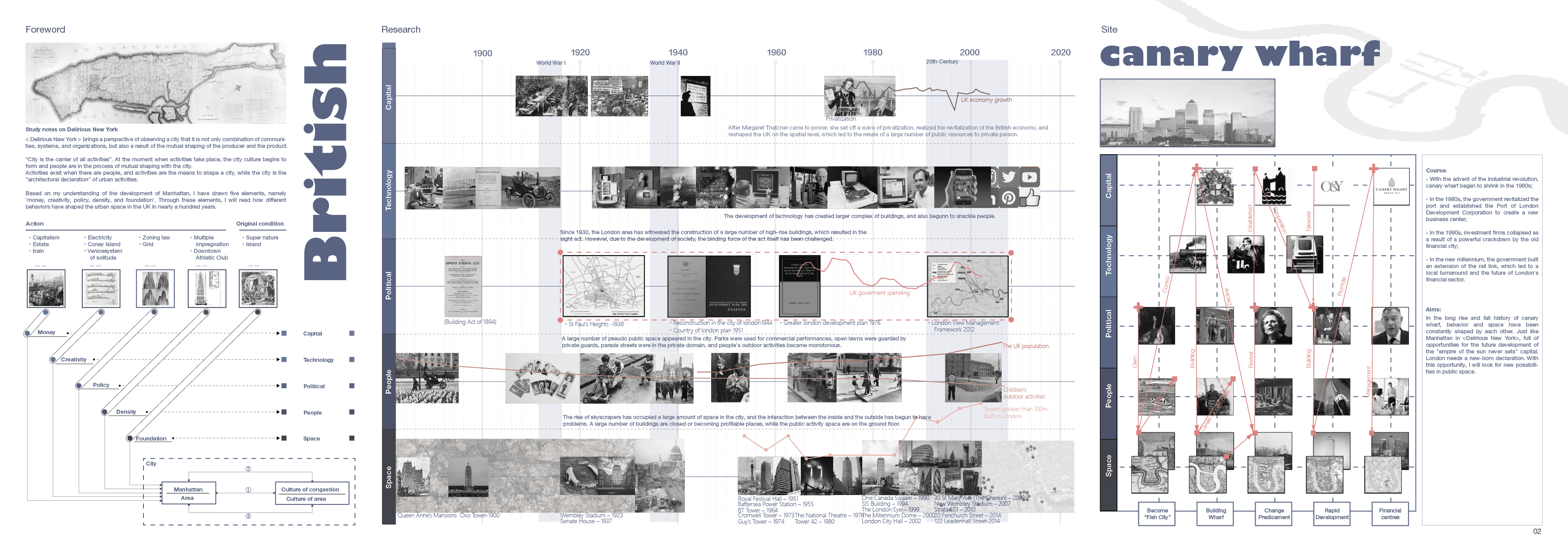
The project begins with the condition of London, where a large number of public services and public lands have gradually been absorbed into privatised systems. In Canary Wharf, this transformation is especially visible: public space appears open, but is increasingly shaped by ownership, management, surveillance, and economic filtering. The project therefore asks who public space really belongs to, and whether a city can still sustain collective life when its supposedly public ground is organised around profitability.
The project begins with the condition of London, where a large number of public services and public lands have gradually been absorbed into privatised systems. In Canary Wharf, this transformation is especially visible: public space appears open, but is increasingly shaped by ownership, management, surveillance, and economic filtering. The project therefore asks who public space really belongs to, and whether a city can still sustain collective life when its supposedly public ground is organised around profitability.
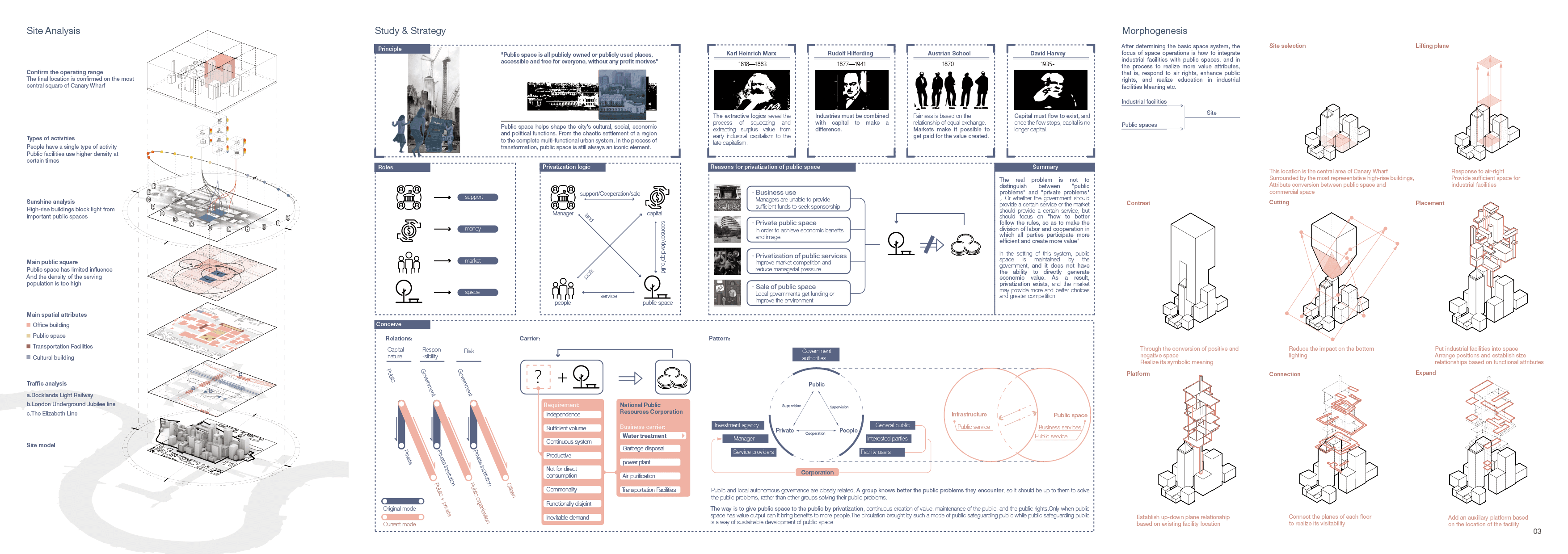
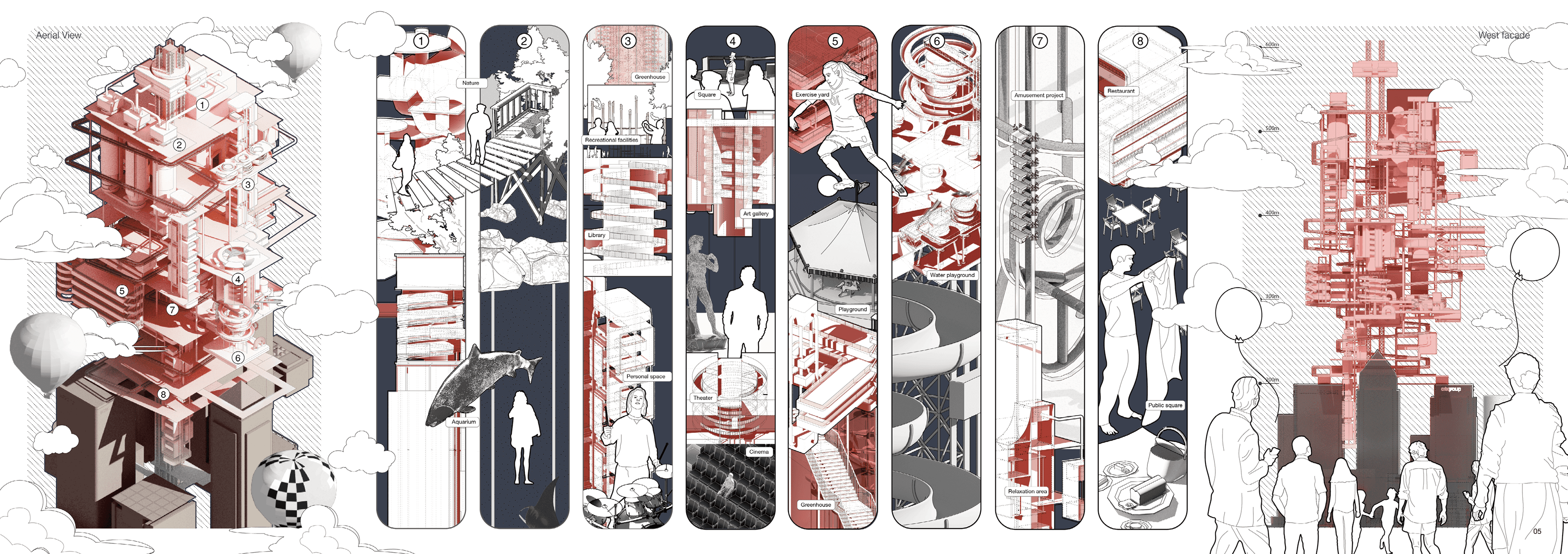
Instead of treating infrastructure as a hidden technical layer beneath the city, the project repositions it as a public carrier. By introducing water treatment systems, waste recycling, air purification, and other urban service mechanisms into the spatial core of the proposal, the design constructs a new relationship between utility and public use. Infrastructure is no longer background support; it becomes a visible and inhabitable framework through which public space can be redistributed and reactivated.
Instead of treating infrastructure as a hidden technical layer beneath the city, the project repositions it as a public carrier. By introducing water treatment systems, waste recycling, air purification, and other urban service mechanisms into the spatial core of the proposal, the design constructs a new relationship between utility and public use. Infrastructure is no longer background support; it becomes a visible and inhabitable framework through which public space can be redistributed and reactivated.
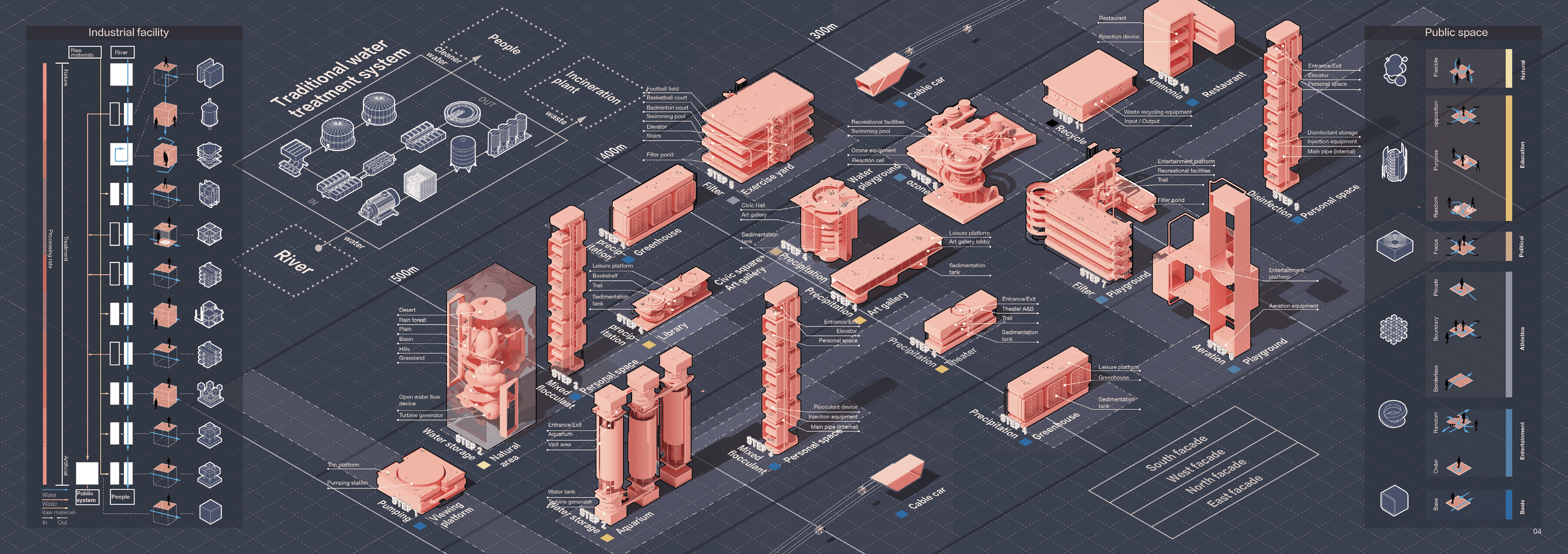
The resulting proposal imagines a vertical public infrastructure in which leisure, education, civic gathering, environmental services, and everyday activities coexist. This is not simply a building, but a manifesto expressed through spatial organisation: a challenge to the dominance of privately controlled urban development and a call to redefine public space as something productive, accessible, and collectively owned in use if not in title. In this sense, the project is less about solving Canary Wharf as a site, and more about using it to expose and counter a broader urban condition.
The resulting proposal imagines a vertical public infrastructure in which leisure, education, civic gathering, environmental services, and everyday activities coexist. This is not simply a building, but a manifesto expressed through spatial organisation: a challenge to the dominance of privately controlled urban development and a call to redefine public space as something productive, accessible, and collectively owned in use if not in title. In this sense, the project is less about solving Canary Wharf as a site, and more about using it to expose and counter a broader urban condition.